
- Experts sound the alarm over Brits’ poor smoke alarm-testing habits
- Jamie Warden, father or two from Ipswich, recalls seeing smoke pouring through the doorframe as his home caught fire
- 9% of people in the East of England admit to never testing their smoke alarm
- Nationally, 7% of Brits admit to never testing their smoke alarm, meaning millions could be putting themselves at risk
- Charity launches ‘Don’t Ignore the Beep’ campaign, urging households to test their alarm and change the batteries
Experts are raising the alarm as millions of households could be at risk of not being alerted to a fire in their home, as Brits admit to never testing their smoke alarm.
A new nationally representative survey of 2,000 adults across the UK by consumer safety charity, Electrical Safety First, reveals 7% of Brits admit to never testing their smoke alarm – the equivalent of 4 million adults across the country.
Now experts are raising serious fears many households may be jeopardising their chance to escape a fire.
“Every second counts when it comes to escaping a fire in your home and smoke alarms can be the life-saving gadget that proves to be the difference between life and death. But they need to be maintained to ensure they operate properly,” said Giuseppe Capanna, product safety engineer at Electrical Safety First.
The charity recommends households test their smoke alarms at least once every month and that households take just a few seconds to build this into their routine at home.
Yet despite this, further research by the charity reveals a mere 22% of Brits test once a month, with 39% of Brits testing their smoke alarm less often than this.
Worryingly almost 1 in 10 test their smoke alarm just once a year or less. “Fires don’t discriminate,” Giuseppe Capanna adds. “Many people affected by fire often tell us they simply didn’t think something like this could happen to them, which is why it’s so important households take just a few seconds to test their smoke alarm. It’s also vital you consider if you have enough of them in your home. Make sure alarms are positioned in areas across your home where a fire could start and that you have at least one on every floor of your property. The more alarms you have, the earlier your warning will be depending on where in your home a fire starts.”
Recent reports demonstrate just how vital a smoke alarm is, with one family in Derbyshire having a lucky escape after being alerted to a fire in the middle of the night in late November last year. The fire, reported to have been caused by an e-bike battery, triggered the working smoke alarms, where the family were forced to escape from a first floor window. Another local report reveals how smoke alarms played a vital role in allowing a family of five the vital minutes needed to escape a fire in North Wales, just before the New Year.
‘IT REALLY COULD BE THE DIFFERENCE BETWEEN LIFE AND DEATH’ - JAMIE’S STORY
Jamie Warden, 38, a father of two from Ipswich, experienced first-hand just how lifesaving working smoke alarms are when last month, a fire caused by a battery charger for car jump leads, gripped his home in the middle of the night, destroying the living room, causing extensive smoke damage throughout the rest of the house, leaving him and his family in temporary accommodation.
Jamie said: “I’d been given the battery charger for car jump leads earlier that day. I put it on charge and had meant to turn it off before we went to bed but completely forgot.
"We were woken at around 3am by the smoke alarms going off. At first, I couldn’t see any smoke, so I went downstairs to see what was happening.
"That’s when I saw so much smoke I could hardly see anything. We had shut the living room and kitchen doors overnight, but the smoke was still spilling through the gaps in the door frames.
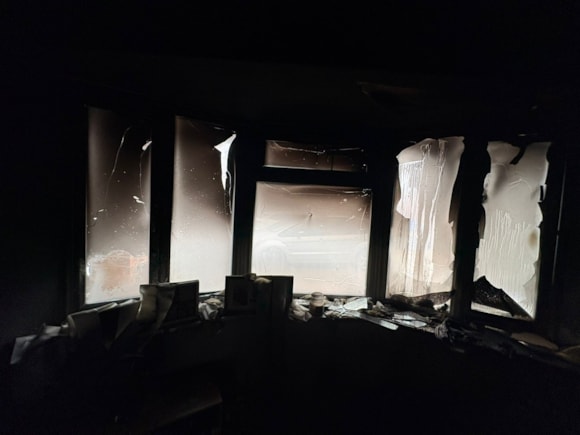
“I ran back upstairs to get my wife and children. Our eldest son is disabled, so my wife picked him up while our youngest followed behind.
“We all made it out safely and called the fire brigade, but then we realised our two 10-month-old cats were still trapped inside.
“I ran back into the house, into the living room where the fire had started, but everything was black, I could only see the flames. I tried to go through the kitchen door as well, but it was just as bad.
“Luckily, the fire brigade managed to rescue the cats. They gave one of them CPR and both were given oxygen. I was able to see them briefly before I was taken to hospital for smoke inhalation after trying to rescue them myself.

“The entire living room was destroyed and the rest of the house suffered smoke damage. All the Christmas presents we’d brought for our sons were ruined, but in the end, we were lucky that was all it was.
“Having the doors shut downstairs was a blessing in disguise, as it helped slow the spread of the fire. Our sofa was also fire retardant, which the fire brigade said helped limit the spread too. But having working smoke alarms was lifesaving. It gave us the warning we needed to get out safely, otherwise it could have been a whole different story.
“It’s too soon to tell the lasting impact it’ll have on us and our children, but we’re trying to not make a big deal out of it for them.“My advice to others would be to make sure you have smoke alarms and that they’re working. Test them regularly, and if you live in rented accommodation, make sure your landlord or housing association deals with any issues. It really could be the difference between life and death.
”To donate to help Jamie and his family get their lives back together after the house fire, visit: https://www.justgiving.com/crowdfunding/tiffany-warden
SMOKE ALARM BLACKSPOTS REVEALED – WHERE DOES YOUR REGION RANK?
Whilst experts raise serious concerns about the infrequent testing of smoke alarms across the country, households are being warned their life could be at risk if they are missing an alarm in their home altogether.
Analysis of Government fire data by the charity also reveals the regions across England where alarms were absent altogether. Analysis of dwelling fires across England reveals that, out of 24,140 accidental electrical dwelling fires between 2023 and 2025 4,498, or 19%, were recorded as having an absent smoke alarm.
“People living in a property without a smoke alarm altogether are at a significantly higher risk of being serious injured or worse, losing their life, in the event a fire grips their home,” Giuseppe Capanna adds, as the Government’s own analysis reveals that people living without a working smoke alarm are 11 times more likely to die in a dwelling fire.
Norfolk topped the list is one of the UK's biggest fire safety blackspots. With smoke alarms absent in 188 homes where accidental electrical fires have broken out in the past two years, Norfolk poses the greatest fire-safety risk per capita.
Avon ranked second (199), followed by Cornwall and the Isles of Scilly (87), Hertfordshire (161), and Nottinghamshire (98), rounding out the top five fire-safety blackspots3.
THE CITIES LEAST LIKELY TO TEST THEIR SMOKE ALARM:
Separate survey data also showed where in the country people are least likely to never test their smoke alarms, and Sheffield ranks the highest in the list, with over 14% of its population admitting to never testing their smoke alarms2. The rest of the top 5 is dominated by major UK population centres, meaning even more people could be putting themselves at risk. Liverpool follows closely, with 11% of residents neglecting to test their smoke alarms. London stands at 9%, while Bristol and Cardiff round up the list, tied at 8%2.
DON’T IGNORE THE BEEP – HOW TO STAY SAFE:As part of Electrical Fire Safety Week, Electrical Safety First is urging households to test smoke alarms at least once a month, replace batteries when needed, never disable smoke alarms, and adopt simple fire-safe habits at home.
- One smoke alarm may not be enough – experts urge homes to ensure they have at least one working smoke alarm on every floor in their home, to ensure they are alerted to a fire as soon as possible, depending on whether it might start.
- Don’t ignore the beep – If your alarm starts to beep never ignore it, this could indicate the battery is low or a fault with the sensor that requires attention.
- Check which type of smoke alarm you have –some are battery operated only, whilst others are mains powered. Whatever type you have it’s essential you test it at least once a month for peace of mind and to ensure it operates properly
- Prevention is better than cure – building in preventative habits into your nightly routine, known as habit stacking, can reduce your risk. For example, when you lock the front door, check the hob is off, or while the kettle is boiling, unplug any unused appliances.