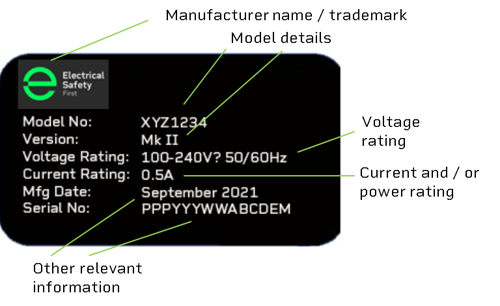
Rating label example
Energy label example
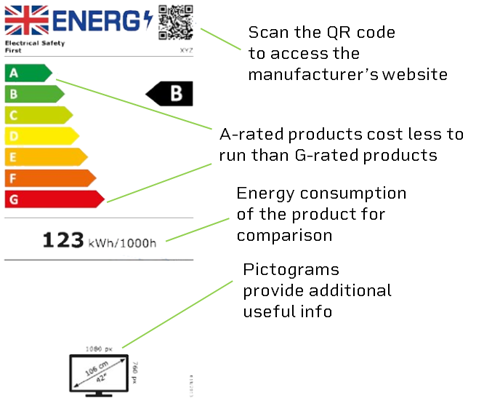


Energy labels give an indication of the energy efficiency and other key features of products to help you make an informed choice when making a purchase.
Checking the energy label before you buy a product gives you an idea of how expensive it will be to run.
Energy labels also give you the amount of electricity used over a certain period of time or for a given number of uses (cycles), measured in kilowatt hours (kWh).
To know the power in watts (W) or kW (kilowatts) of an appliance you need to know how the energy efficiency rating was calculated. Unfortunately, this calculation differs depending on the type of product.
For example, a TV’s rating is measured in kWh per 1,000 hours and a washing machine’s rating is based on kWh per 100 cycles at an eco-wash setting.
It’s easier to just look at the power rating label on the product or the packaging (see an example of a rating label below).

If the power is constant and you know the timeframe, just take the kWh number and divide it by the number of hours e.g. 10kWh over five hours = 2kW.
If you need the answer in watts (W) instead of kilowatts, multiply the answer by 1000. e.g. 2 x 1000 = 2000.
If the power of your appliance is not constant, look at the rating label (required for all manufacturers to have on their appliance). This shows either the power of the appliance, or the current of the appliance.
Then use our Units Calculator to get the rating information that you need.

Don't ignore burn marks, ‘arcing’ (buzzing or crackling) sounds, fuses blowing, circuit-breakers tripping, or if it feels hot to touch.
Unplug and contact the retailer, manufacturer, or a qualified repair technician.
An RCD (residual current device) in your consumer unit (fusebox) protects you from electric shocks if a product is faulty.
If you don’t have RCD protection, use an RCD plug on the socket where the product is plugged in.
Ensure there is at least one smoke or heat alarm per floor in your property. Fit enough alarms to cover all areas where a fire could start.
Test alarms at least once a month. Replace them every ten years or when the replace by date is reached.

Answers to commonly-asked questions we receive about electrical safety.
If you have purchased an electrical product that you believe to be unsafe, you should contact the manufacturer to let them know of your concerns.
If they do not deal with this to your satisfaction, you should report the product to your local Trading Standards Office and they will be able to investigate further.
We recommend that you register all of your electrical appliances so that, in the event of a problem, the manufacturer can contact you to let you know about it. You can find out more here.
You should contact either Trading Standards or Citizens Advice to register your concern.
If you want to forward us supporting documentation and images relating to the product, we can objectively review its safety. Send it to enquiries@electricalsafetyfirst.org.uk
We recommend you don't bring home electrical products purchased from outside the UK.
However, an EU conversion plug could make some appliances safe for use in the UK:
A statement of compliance must be a document that accompanies the in-scope product. PSTI however does not define the term “accompany”. A physical copy of the statement provided with the product should suffice however it does not necessarily need to be in a separate document. It could be included in the packaging or the instructions for use that accompany the product.
The statement could be in a digital form. However, if you make available an in-scope product that does not come with a physical copy of the statement, you need to be able to show that the digital statement for that product ‘accompanies’ the product.
Use of a summary statement is currently not permitted. All information required under PSTI (https://www.legislation.gov.uk/uksi/2023/1007/schedule/4/made) must be included in the statement.

Electrical products are recalled more regularly than you might think, but the response rate to a recall is often worryingly low. This means there are potentially millions of recalled electrical items still in UK homes.

Whether you are a member of the public or an electrical professional, we will keep you in the know with the latest electrical safety news and information.